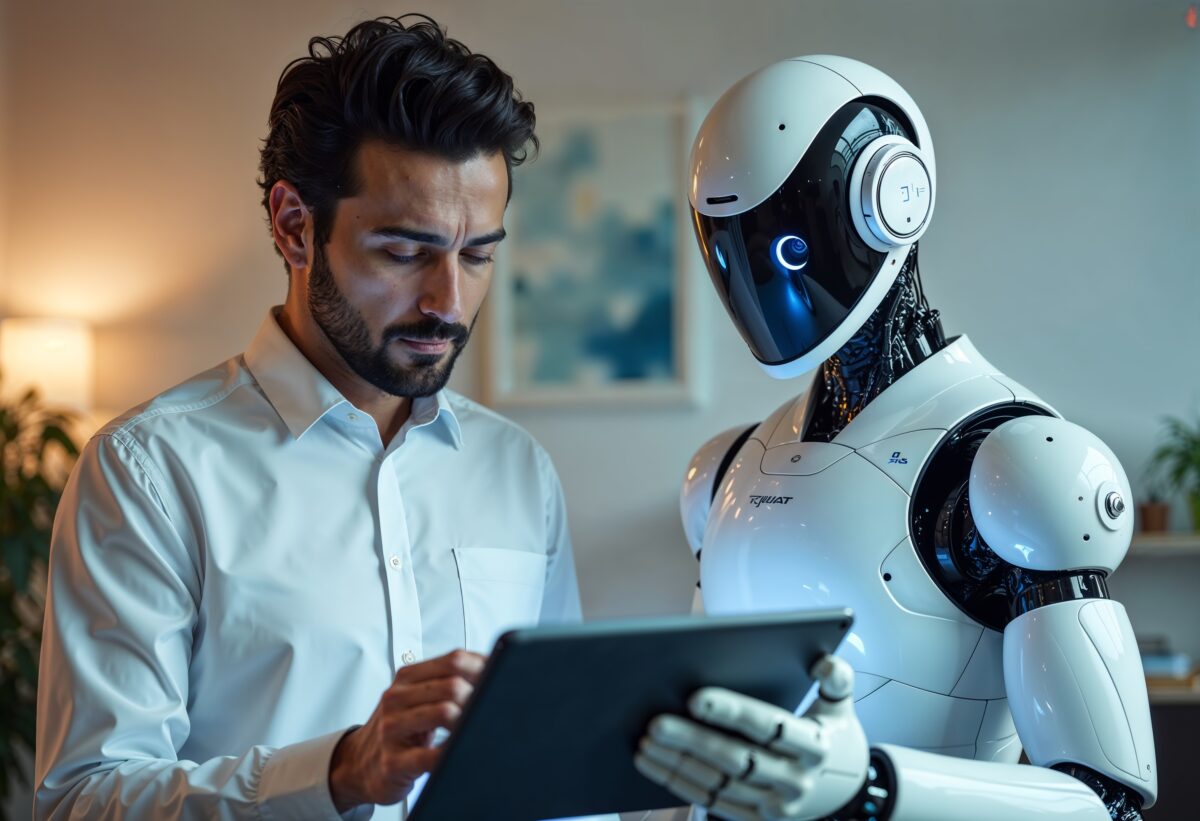
New Conceptual Analysis Highlights Key Gaps Between Human Reasoning and AI

Why can an AI generate a brilliant poem in seconds, yet struggle with simple real-world logic? While artificial intelligence seems increasingly human-like, scientists are exploring the structural differences between machine output and human thought. A new conceptual analysis proposes that while language models combine ideas through learned statistical patterns, humans build new concepts using internal goals, physical experience, and cause-and-effect relationships: a distinction that may help explain why human reasoning remains more adaptable in unfamiliar situations. The analysis maps key differences in how humans and artificial intelligence construct new meanings.
Note: This article is intended for general information and educational purposes. It summarizes scientific research in accessible language for a broad audience and is not an official scientific press release.
How do humans create new ideas? We often take familiar concepts, select the parts that matter, and combine them into something entirely new. In cognitive science, this process is known as conceptual blending.
Consider the words “houseboat” and “boathouse.” Both combine the concepts of a house and a boat, yet we immediately understand that they mean very different things (a houseboat is a boat designed for people to live in, while a boathouse is a building used to store boats). Our minds do not simply merge every feature of both concepts. Instead, we select the specific features that make sense for a particular meaning or goal. Artificial intelligence can also combine existing concepts to produce surprisingly novel ideas. But does an AI system create them in the same way as the human mind?
A conceptual analysis by Spencer K. Lynn of the Division of Human-Centered Artificial Intelligence at Charles River Analytics explores this question. Published in Frontiers in Psychology on July 29, 2026, the paper compares how humans and large language models (LLMs) construct new meanings.
The proposed distinction is striking: human thinking is grounded in internal goals, physical experience, action, and causal relationships, while language models generate new combinations primarily from learned statistical patterns and externally supplied instructions.
What the Researcher Investigated
The paper addresses a fundamental puzzle in cognitive science: when several concepts could be combined, what determines which features are kept and which are ignored?
Lynn proposes that, in humans, the answer is closely connected to our goals and our interaction with the physical world. Human conceptual blending is described as generative-causal. When we encounter something unfamiliar, we draw on previous knowledge to understand what it is, what it can do, and how it might help us achieve a specific goal.
Language models work differently. Lynn characterizes their blending as distributionally novel. LLMs learn complex patterns from enormous amounts of data and generate new combinations that are consistent with those learned patterns, guided by prompts, alignment, context, and decoding procedures.
The distinction is therefore not simply about whether humans or AI can be creative. Both can produce novel combinations. The core question is what drives the selection and purpose behind those combinations.
How the Analysis Was Conducted
This was a conceptual study rather than an experiment with human participants. Lynn reviewed research from cognitive science, neuroscience, and artificial intelligence, and created a small computer model to illustrate how goal-directed conceptual blending might work.
The model uses an imaginary example of a person seeing a V-22 Osprey for the first time. This aircraft was chosen because its technical design combines features of both an airplane and a helicopter, so it may not be immediately clear how it flies. By combining relevant knowledge about airplanes and helicopters, the person forms an idea of its flight capabilities. Their goal helps determine which features matter.
The model illustrates the proposed framework but does not establish that the brain uses this exact mechanism. Predictive processing also remains an actively debated theory in cognitive science.
What Makes This Analysis Different
While it may seem obvious that AI lacks a physical body, the analysis examines a deeper question: how does this difference affect the way humans and language models construct new meanings? Rather than treating AI as either “sentient” or a “simple pattern matcher,” Lynn compares the different control architectures that may underlie human and language-model conceptual blending.
The analysis focuses on where the purpose behind a new idea comes from.
For humans, goals exist within an embodied biological system. We have physical needs, perceive our surroundings, act on the world, observe consequences, and revise our understanding when an idea fails. This allows humans to understand objects in terms of affordances, the possibilities for action that an object offers relative to a goal. Imagine needing to reach an object above your head. A chair is normally associated with sitting, but your goal leads you to perceive it as a temporary stepstool. The object’s physical properties have not changed; what changes is which properties become relevant to your active goal.
LLMs lack this biological grounding. Their apparent goals are introduced externally through training objectives, alignment, prompts, context, and decoding procedures. Lynn terms these proxy-goals.
Key Arguments from the Analysis
1. Human Ideas Are Connected to Goals and Action
Under Lynn’s framework, human conceptual blending is closely tied to what we are trying to accomplish. We do not need to process every possible property of an object. Our goals direct attention toward the features that matter.
If a person needs to change a lightbulb, a chair can become a temporary stepstool. The goal makes its ability to provide height and support weight relevant, while other properties become less important. Affordances are central to human conceptual flexibility: concepts are connected not only to what things are, but also to what we can potentially do with them.
2. Language Models Build Novel Ideas from Learned Patterns
LLMs generate responses by identifying complex patterns learned from large amounts of text and predicting which words are most likely to come next. This allows them to combine familiar concepts in coherent, creative, and sometimes genuinely novel ways.
However, the paper argues that these ideas are not grounded in the model’s own physical goals or experiences. An LLM can suggest using a chair as a stepstool, but it cannot physically test whether the chair is stable, observe what happens, or learn directly through bodily experience if the idea fails.
When a prompt includes several competing requirements, the model may also struggle to balance them. Instead of fully satisfying each one, it can produce a generic compromise that sounds appropriate but does not completely meet any of them.
3. Humans Can Test Ideas Against the Physical World
A crucial distinction highlighted in the analysis is the human perception-action feedback loop. People can form an idea, act on it, observe what happens, detect an error, and update their mental model persistently. We can also counterfactually simulate outcomes before acting.
Language models can adapt transiently to information within their current context window. Modern AI systems can also extend their capabilities using external tools, memory modules, and multimodal inputs. However, Lynn argues that the core language-model architecture lacks an intrinsically motivated, embodied loop connecting physical goals, perception, action, and persistent model revision.
This distinction becomes particularly important when facing genuinely unfamiliar problems that require causal reasoning, long-horizon planning, real-world intervention, and adaptive model updates.
Author’s Conclusions
The paper does not suggest that LLMs cannot generate novel or useful outputs. They can combine concepts in sophisticated ways and capture complex relationships present in their training data.
The deeper distinction lies in how new meanings are constructed and what gives them purpose. Human conceptual flexibility is embedded in a biological system that interacts with the physical world. Our goals help determine which information matters, our knowledge of causal relationships helps us anticipate outcomes, and feedback from physical action allows us to revise unsuccessful ideas.
LLMs operate differently. Their outputs are guided by learned statistical relationships alongside training objectives, alignment, prompts, context, tools, and decoding heuristics.
According to Lynn, this architectural difference may help explain why language models appear highly capable in well-structured contexts, yet become brittle when confronted with open-ended problems requiring persistent goals, causal understanding, physical interaction, and real-time adaptation.
What Could This Mean for Future AI?
The paper suggests that making AI more adaptable may require more than simply increasing model size, training data, or context length.
Lynn proposes adding an affordance layer that would help an AI system connect a goal with possible actions and their likely consequences. In theory, this could allow the system to compare different solutions, anticipate what might happen, use feedback, and revise its approach when an idea does not work.
According to the paper, this would shift the focus from predicting “What word should come next?” toward evaluating “What action or solution could best achieve this goal?” This is a proposed direction for future AI research, not a capability demonstrated by the analysis.
Understanding the Broader Context
This analysis contributes to the scientific discussion about the architectural differences between biological intelligence and machine learning systems. By examining conceptual blending through predictive processing and embodied cognition, the paper offers a framework for understanding how humans and computational systems may differ in selecting relevant information, constructing new meanings, and responding to unfamiliar situations.
Conclusion
Humans and AI can produce remarkably similar ideas, but Lynn’s analysis suggests they may arrive at them in fundamentally different ways.
Language models build new combinations from learned patterns and externally supplied instructions. Human cognition, by contrast, is shaped by goals, physical experience, causal understanding, and the ability to act, observe the outcome, and adapt.
For cognitive science, this difference points to one of the most remarkable features of the human mind: we do not simply combine information, we decide what matters based on what we are trying to achieve. Understanding this goal-driven flexibility may help explain both why humans can adapt to unfamiliar situations and what future AI systems may still need to learn.
The information in this article is provided for informational purposes only and is not medical advice. For medical advice, please consult your doctor.
Reference:
Lynn, S. K. (2026). Conceptual blending in humans and language models. Frontiers in Psychology, 17:1849083. DOI: 10.3389/fpsyg.2026.1849083