Why Nostalgia Feels Good: New Research on Connection and Gratitude

An old song comes on at the grocery store, and for three minutes you are seventeen. That warm rush leaves a familiar path in the mind. Studies published in 2025 and 2026 hint at its social side too: nostalgia tends to leave people feeling more connected to others, and more grateful for them.
Nostalgia started as a diagnosis. A Swiss medical student, Johannes Hofer, coined the term in 1688 to describe the severe homesickness he saw in Swiss mercenaries serving far from home. Hofer considered it a disease of the brain. He built it up from two Greek roots, nostos (homecoming) and algos (pain). Halfway the pain. Doctors considered nostalgia a medical disease for centuries. By the beginning of the 20th century, it was redefined as a psychiatric disorder (Sedikides et al., 2008).
Since then, psychology has reversed that verdict. Constantine Sedikides, Tim Wildschut, and their colleagues at the University of Southampton have been studying nostalgia for twenty years, characterizing it as a predominantly positive, social emotion (Wildschut et al., 2006). That’s also common. In early research, more than 80 percent of British undergraduates reported feeling nostalgic at least once a week.
More recent research takes one step further. Researchers already knew nostalgia tends to feel good, so they asked what it does next: how it shifts the way people see their relationships, and whether it makes them more grateful for the people in those relationships.
What Is Nostalgia, and Why Does It Feel Bittersweet?
The psychology of nostalgia begins with a simple definition: a sentimental longing for the past. Sentimental value does the heavy lifting. A feeling attached to a nostalgic memory usually stems from a moment that mattered.
Wildschut and colleagues studied people’s written accounts of nostalgic experiences and found a consistent pattern (Wildschut et al., 2006). The writer was the main character, often with friends or family, or at the center of a big event, such as a wedding. Positive feelings outnumbered negative ones. Many of the accounts followed a redemption arc, too, where an early low point gave way to something better.
Put those pieces together, and you get the bittersweet quality: a sting, because that time is gone, and a landing that is mostly warm.
Two neighbors get confused with nostalgia. Homesickness is about a place you want to go back to right now. Rumination is repetitive thinking that circles a problem without resolving it. At its best, nostalgia is more like a short visit than a move back.
Why Nostalgia Feels Good in the Brain
So why does nostalgia feel good when it’s partly about loss? Two brain systems seem to share the credit.
In a 2016 fMRI study from Japan, healthy women viewed pictures connected to childhood (Oba et al., 2016). Images they found nostalgic produced activity in memory and reward regions alike, including the hippocampus, which is central to autobiographical memory, and the ventral striatum, part of the brain’s reward circuitry. The two regions also activated together, and the stronger a participant’s general tendency toward nostalgia, the stronger the co-activation.
A nostalgic moment, then, looks like the brain pulling up a memory and flagging it as valuable at once. The study had real limits (only women took part, and everyone saw researcher-chosen pictures instead of personal photos), so it’s one piece of the picture.
Age matters too. When older adults recall their most vivid and important memories, a disproportionate share comes from roughly ages 10 to 30 (Rubin et al., 1998). That same window is where people’s favorite music, films, and books tend to come from, and researchers call the pattern the reminiscence bump. It helps explain why a song from high school can hit harder than a better one released last month. (Your teenage taste is not on trial here.)
New Research Links Nostalgia to Social Connection
If nostalgia were only a private pleasure, it wouldn’t be much of a story. The newest findings give it a social purpose.
In January 2026, Sedikides, Wildschut, and colleagues published four experiments in Self and Identity, with more than 3,500 participants across them (Sedikides et al., 2026).
Three used the Event Reflection Task, the most common lab method for recalling a nostalgic memory. The fourth used virtual reality.
- The samples were broad. They included 441 adults across the lifespan, 2,521 people from 28 regions, 416 people in Gaza living with chronic adversity, and 128 participants recruited online through Prolific.
- The pattern repeated. Nostalgia reliably raised social connectedness, meaning a sense of belonging and acceptance, and that connectedness predicted higher self-esteem.
- It was held across groups. The link between nostalgia and social connection held regardless of gender and age, and across cultural measures such as individualism versus collectivism, wealth, and happiness.
The authors define nostalgia as a social emotion that increases self-esteem by boosting a sense of belonging. In this work, nostalgia benefited relationships. First, people felt more connected; second, people felt better about themselves.
In a 2025 paper in Cognition and Emotion, the same question is approached from a different angle (Huang & Chang, 2025). Across three studies (1,467 undergraduates, an online panel, and a Dutch population sample followed over time), people higher in trait nostalgia were more motivated to maintain their social networks.
These results are correlational, so they can’t prove nostalgia grows anyone’s friend circle. They do suggest that people who value their past relationships keep investing in the current ones, which fits what CogniFit has covered on how community and connection shape the lives of older adults.
Why Nostalgia and Gratitude Often Arrive Together
On the surface, gratitude and nostalgia face opposite ways, one toward the present and one toward the past. A paper published in late 2025 in Personality and Individual Differences argues the two are closely tied (Green et al., 2025).
Researchers from Virginia Commonwealth University and the University of Southampton tested the idea three ways:
- A snapshot. People higher in trait nostalgia were more likely to report gratitude.
- Over time. In a longitudinal study, trait nostalgia predicted gratitude 16 months later.
- An experiment. People who listened to a nostalgic song reported more gratitude than people who heard a cheerful control song.
That control song makes the experiment hard to dismiss. It was upbeat too, so a simple good-mood effect is an unlikely explanation for the gap. In all three studies, social connectedness accounted for the link: the nostalgic memory brought people’s relationships to mind, and feeling connected to those people made gratitude more likely.
The authors are candid about the weak spots. Two of the studies used brief measures, and the longitudinal one relied on agreeableness as a stand-in for social connectedness. Their practical suggestion is worth borrowing anyway. Schools already practice nostalgia informally through reunions and homecoming weekends and could build those traditions more deliberately, and organizations could revisit their shared history in the same spirit.
CogniFit’s 5-minute guide to how gratitude may change your brain covers one route to that feeling. Nostalgia offers another route, starting in the past.
What Triggers Nostalgic Memories in Everyday Life
Nostalgia rarely arrives on schedule. Something sets it off. The Southampton group’s early studies identified negative mood and loneliness as triggers (Wildschut et al., 2006). Senses can do it too. Smells, tastes, and music can all bring nostalgia on (Green et al., 2025), and both the gratitude experiment above and the temperature study below used songs to remember it.
Temperature plays a part, oddly enough. A five-study paper in Emotion found that people felt more nostalgic on colder days and in a cold room than in a neutral or warm one (Zhou et al., 2012). When participants in a cold room recalled a nostalgic event, they judged the room as warmer than people who recalled an ordinary one. The paper is titled “Heartwarming Memories,” and for once the pun comes with data.
Because so many triggers arrive through the senses, the objects people keep around them can prompt them. A recipe card in a grandmother’s handwriting is a retrieval cue. So is a ticket stub from a first concert, or a playlist built around one particular summer. Each hand remembers a thread to pull.
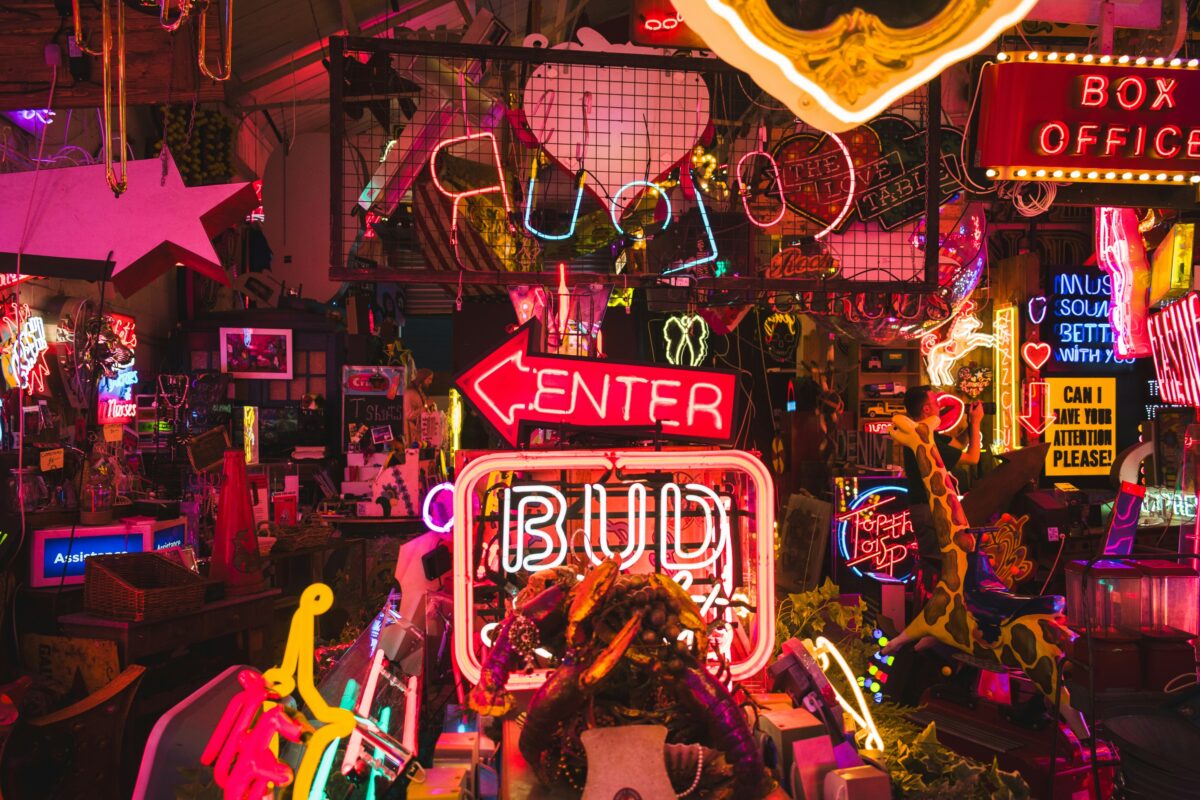
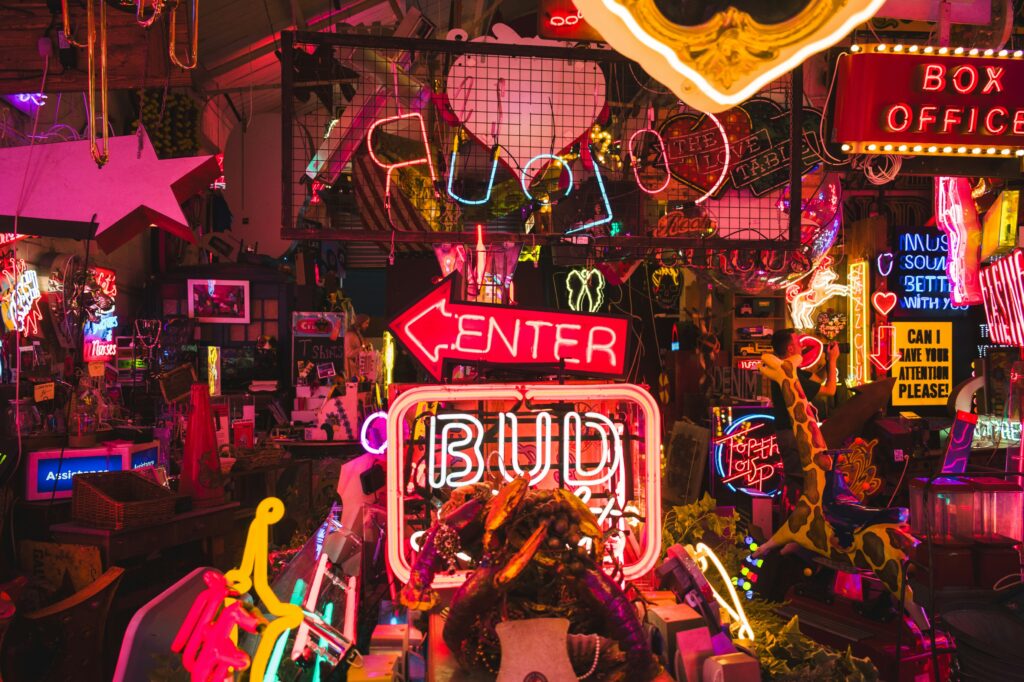
Neon is a case where the cue is cultural as well as personal. Neon signs reached the United States in the 1920s. The popular origin story credits a Los Angeles Packard dealer with importing the first two in 1923, though no firm evidence for that date has turned up, and the earliest photos of a neon sign in Los Angeles date to 1925.
By 1940, nearly 2,000 small shops were producing neon signs. That history gives neon a built-in retro feel, and custom neon signs can pair that feel with something personal, like the name of a grandparents’ diner or a phrase a parent always said at dinner.
No study has tested signs or decor as nostalgia cues directly, and a cue only works when it points to a memory you actually have. A thrift-store record sleeve with no story behind it is just a record sleeve.
Is Nostalgia Always a Good Thing?
Not always. Two lines of research show where it can go sideways.
A 2012 study in the European Journal of Social Psychology induced nostalgia with a visual imagery task (Verplanken, 2012). Right afterward, participants felt more positive; habitual worriers included.
Then things changed for the worriers. They went on to show more signs of anxiety and depressed mood on the study’s measures than worriers in a comparison group. The author suggested that a vivid memory of a carefree past can sharpen the contrast with a stressful present and invite more rumination.
Psychologist Krystine Batcho has written about anticipatory nostalgia, which means missing the present before it has become the past (Batcho, 2020). Think of feeling wistful at a birthday party that is still going on. Her work treats it as one way nostalgia can tilt toward sadness.
A workable rule: nostalgia helps when it sends you back to the present with something useful, like a clearer sense of who matters to you. It stops helping once the past becomes the preferred place to live. If looking back regularly leaves you feeling worse instead of warmer, talk it over with someone you trust or a qualified professional.
How to Use Nostalgia Without Living in the Past
None of these studies tested a wellness routine, and nostalgia isn’t a treatment for anything. The lab methods are simple, though, and they translate into everyday habits that fit what the researchers found.
Try this:
- Borrow the lab method. Give yourself five minutes. Bring to mind a specific, meaningful event from your past and let yourself relive it. Jot down a few keywords that capture it, then write a couple of lines about how it made you feel and who was there.
- Choose memories with people in them. Social connectedness carried the effect in the studies above. A road trip with your sister will probably do more for your sense of connection than a memory of a great sandwich (the sandwich still deserves respect).
- Use music on purpose. Songs from your teens and twenties fall inside the reminiscence bump, and in the Green et al. experiment, one nostalgic song was enough to shift gratitude.
- Send the memory to the people in it. Text the old photo to the friend who’s in it, or call the aunt whose recipe you just cooked. Nostalgia and relationship upkeep tend to travel together, so let one lead to the other.
- Notice when it tips. If a memory starts turning into a comparison with a disappointing present, switch to something in the here and now, like a walk or a conversation.
Five minutes in the past is plenty. The phone call afterward is what counts.
The information in this article is provided for informational purposes only and is not medical advice. For medical advice, please consult your doctor.
References
- Batcho, K. I. (2020). When nostalgia tilts to sad: Anticipatory and personal nostalgia. Frontiers in Psychology, 11, 1186. https://doi.org/10.3389/fpsyg.2020.01186
- Green, J. D., Wildschut, T., Sedikides, C., Kneuer, M. A., Hedgebeth, M. V., Di Lauro, I. L., & Barrientos, S. A. (2025). Nostalgia enhances gratitude by fostering social connectedness. Personality and Individual Differences, 252, 113602. https://doi.org/10.1016/j.paid.2025.113602
- Huang, K.-J., & Chang, Y.-H. (2025). The past that ties us together: Nostalgia strengthens social networks. Cognition and Emotion, 39(8), 1841–1856. https://doi.org/10.1080/02699931.2025.2451313
- Oba, K., Noriuchi, M., Atomi, T., Moriguchi, Y., & Kikuchi, Y. (2016). Memory and reward systems coproduce “nostalgic” experiences in the brain. Social Cognitive and Affective Neuroscience, 11(7), 1069–1077. https://doi.org/10.1093/scan/nsv073
- Rubin, D. C., Rahhal, T. A., & Poon, L. W. (1998). Things learned in early adulthood are remembered best. Memory & Cognition, 26(1), 3–19. https://doi.org/10.3758/BF03211366
- Sedikides, C., Hepper, E. G., Yılmaz-Özdemir, İ., Abu-Rayya, H. M., & Wildschut, T. (2026). Self in relationships, nostalgically. Self and Identity. https://doi.org/10.1080/15298868.2026.2613847
- Sedikides, C., Wildschut, T., Arndt, J., & Routledge, C. (2008). Nostalgia: Past, present, and future. Current Directions in Psychological Science, 17(5), 304–307. https://doi.org/10.1111/j.1467-8721.2008.00595.x
- Verplanken, B. (2012). When bittersweet turns sour: Adverse effects of nostalgia on habitual worriers. European Journal of Social Psychology, 42(3), 285–289. https://doi.org/10.1002/ejsp.1852
- Wildschut, T., Sedikides, C., Arndt, J., & Routledge, C. (2006). Nostalgia: Content, triggers, functions. Journal of Personality and Social Psychology, 91(5), 975–993. https://doi.org/10.1037/0022-3514.91.5.975
- Zhou, X., Wildschut, T., Sedikides, C., Chen, X., & Vingerhoets, A. J. J. M. (2012). Heartwarming memories: Nostalgia maintains physiological comfort. Emotion, 12(4), 678–684. https://doi.org/10.1037/a0027236