Your Brain’s Digital Twin: How AI Could Transform Mental Health and Cognitive Wellbeing

What if your brain had a digital twin – an AI-powered mirror that learns with you, adapts to your moods, and anticipates your cognitive needs? In this article, we explore the emerging concept of Digital Cognitive Twins, a bold vision at the intersection of neuroscience and artificial intelligence that could transform how we understand and support mental wellbeing.
Think about the last time you misplaced your keys, forgot why you walked into a room, or struggled to focus during an important meeting. These small hiccups are part of everyday life, but they remind us of something bigger: our brains are at the core of who we are.
Cognitive health – our ability to think, remember, pay attention, and make decisions – is essential not only for success at work or school but also for our wellbeing and independence as we age. Yet cognitive challenges are widespread. Anxiety, depression, stress, sleep problems, and age-related conditions like dementia can all chip away at how our minds function.
Here’s the sobering reality: up to 40% of dementia risk may be preventable or at least delayed through lifestyle, behavioral, and medical risk modifications. Things like better sleep, exercise, diet, and education make a difference. But even with those efforts, there is no universally effective treatment to fully prevent conditions like Alzheimer’s disease.
That’s where technology – and a new scientific vision – comes in. Researchers from Duke University, Columbia University, and CogniFit recently outlined a bold idea in Nature Mental Health: the Digital Cognitive Twin (DCT). Imagine a virtual “mirror” of your brain that learns alongside you, predicts your cognitive needs, and helps prevent mental health struggles before they start.
In this post, we’ll explore this concept in depth. We’ll start by looking at the history of brain training, then explain what a DCT is, how it works, and what it could mean for everyday life. Along the way, we’ll use real-world examples so you can picture what this technology might feel like in practice.
From Brain Games to Digital Twins
The rise of brain training
Back in the early 2000s, “brain games” were all the rage and many apps promised sharper memory, faster thinking, and protection against cognitive decline. Sudoku puzzles, crossword apps, and memory games became popular tools marketed as ways to “train your brain.”
Most of this App dont deliver on their promises but just very little have scientific validations proving their claims.
Research showed that cognitive training could improve performance on the exact tasks people practiced. If you played a lot of memory games, you got better at them. But there was a catch: these improvements often didn’t transfer to everyday life. Being a Sudoku master didn’t necessarily mean you’d remember your grocery list better.
Progress and limits
Despite the hype, science did uncover real value. In fact, the U.S. Food and Drug Administration (FDA) has cleared some digital therapeutics – computerized cognitive training programs – for conditions like ADHD and major depressive disorder. Trials have also shown benefits in mild cognitive impairment (MCI), a precursor to dementia.
But challenges remain. High dropout rates, low engagement, “cookie-cutter” programs, and limited personalization mean that many people abandon brain training apps before they see meaningful results.
The shift toward integration
Historically, brain training was often treated as a stand-alone product. But modern neuroscience shows that cognition is deeply intertwined with physical health, emotional wellbeing, and lifestyle. Stress, poor sleep, or lack of physical activity can affect memory and attention just as much as a puzzle game can improve them.
That’s why researchers argue the next generation of brain health tools must take a holistic approach: integrating mental, physical, and emotional health, while leveraging cutting-edge artificial intelligence (AI).
Enter the Digital Cognitive Twin.
What Exactly Is a Digital Cognitive Twin?
The term “digital twin” comes from engineering and healthcare. A digital twin of a jet engine, for example, is a real-time digital replica that mirrors how the physical engine is performing. Engineers use it to predict failures, optimize performance, and plan maintenance.
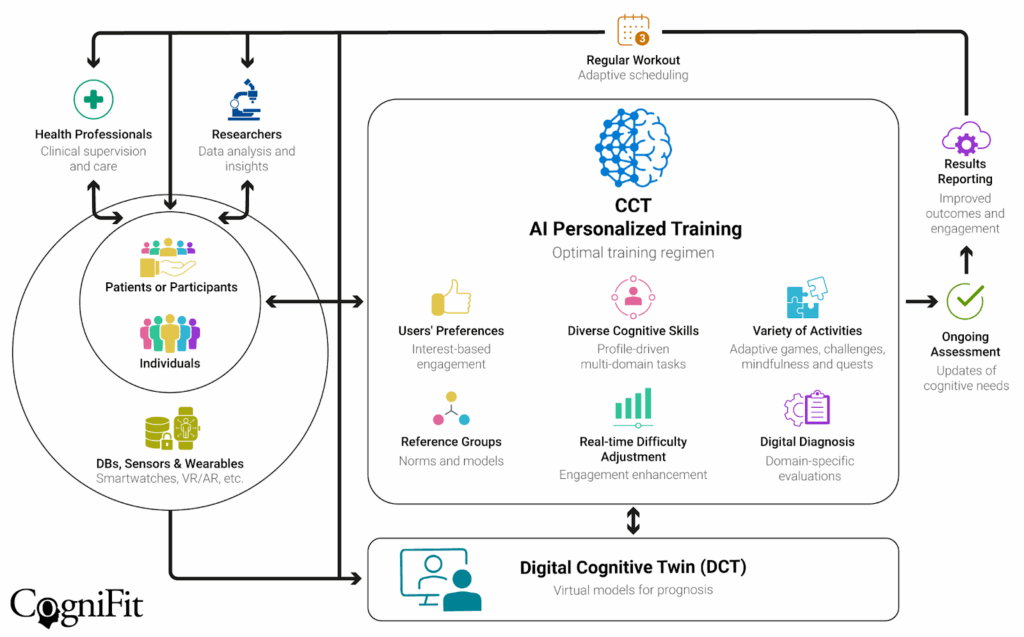
A Digital Cognitive Twin (DCT) works the same way – but for your brain. It’s a continuously updated digital model of your cognitive state, fueled by data from your daily life.
How it works:
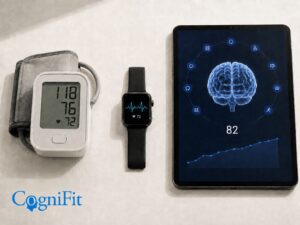
- Data inputs: Your smartwatch tracks your sleep and heart rate. Your phone records activity patterns. Short digital tests check memory, attention, or mood.
- AI integration: These streams of data feed into a machine learning system that identifies patterns and updates your digital twin.
- Personalized predictions: The DCT predicts your daily cognitive needs and suggests personalized interventions – from a calming exercise when stress is high to a memory challenge when you’re alert.
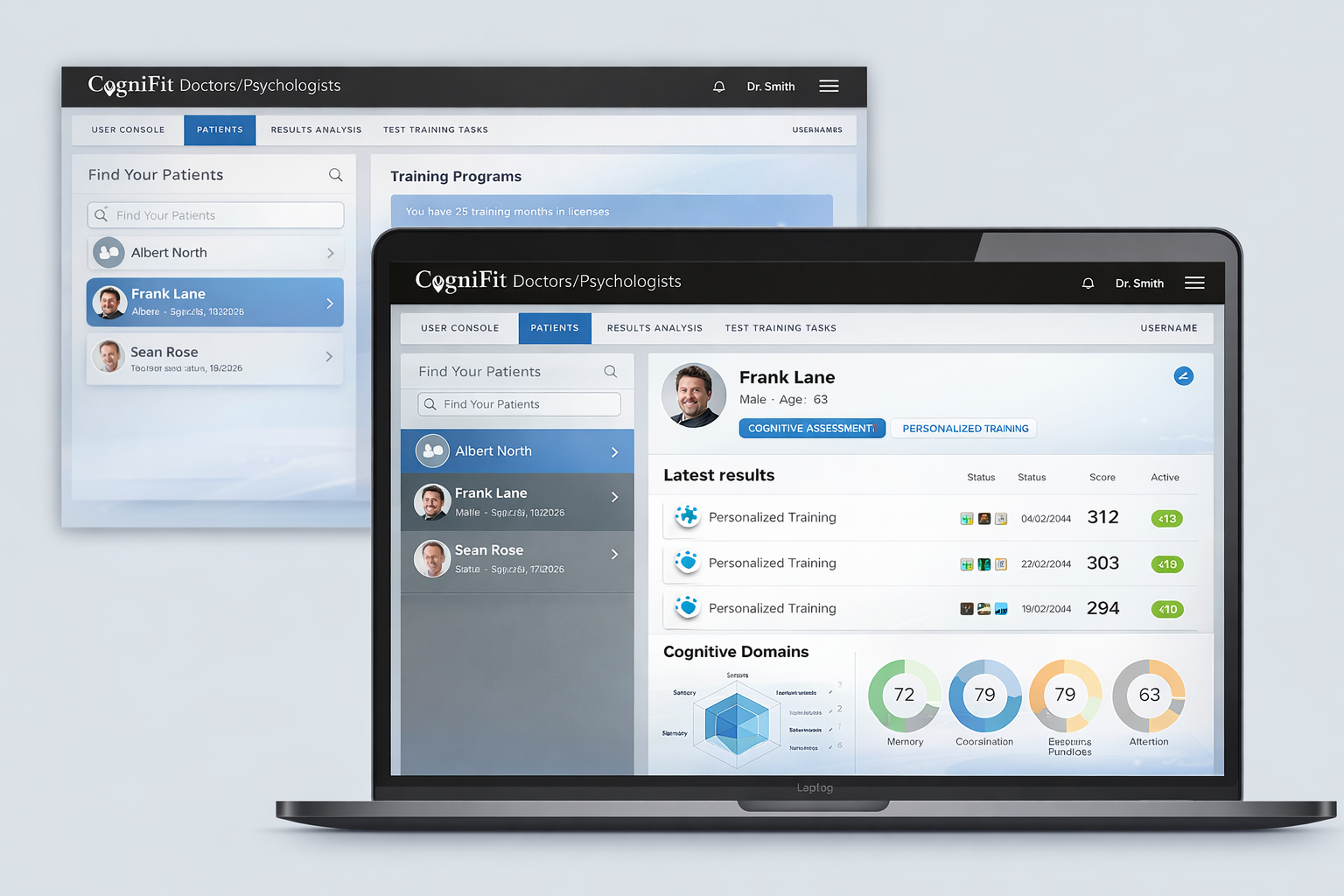
- Clinical insights: For patients, doctors could view a dashboard summarizing trends, risks, and recommended actions.
Everyday Example: Stress at work.
You’re having a busy afternoon. After a tense meeting, your smartwatch picks up that your heart rate has spiked. Your DCT recognizes this and adjusts your training plan. Instead of pushing you into a demanding working-memory task, it prompts a short guided breathing session. Later that evening, when you’re calmer, it nudges you to tackle a memory challenge.
In this way, the DCT becomes like a personal brain coach, adapting not only to who you are but also to how you feel in the moment.
How AI Personalizes Mental Health Support
Traditional mental health research relies on randomized controlled trials (RCTs). These are still the gold standard, but they are often rigid: the same intervention is given to everyone, regardless of personal differences.
Digital Cognitive Twins require more flexible approaches. Scientists now use designs like micro-randomized trials (MRTs) and just-in-time adaptive interventions (JITAIs). These allow researchers to study how small, real-time adjustments – like switching a task or sending a motivational message – impact outcomes.
Why personalization matters: Everyone’s brain is unique. A strategy that helps a college student with exam anxiety might not work for a retiree with early memory loss. Personalization increases the odds of success and helps people stick with programs over time.
Everyday Example: Netflix for your brain.
Think about how Netflix recommends movies. It doesn’t just show you the “top 10.” Instead, it learns from your preferences – what you watched, when you stopped, what you rated – and curates recommendations for you.
A DCT does the same for mental health. It learns from your sleep patterns, stress levels, and engagement history to create a personalized “playlist” of cognitive exercises and wellbeing activities.
Beyond Screens: Multimodal Brain Engagement
One of the biggest limitations of current brain training apps is that they mostly involve tapping on a screen. But the human brain is multimodal: it processes information from vision, hearing, movement, touch, and emotions all at once.
DCTs could expand brain training into immersive, real-world experiences.
What multimodality looks like:
- Voice interfaces: Talking to your digital assistant instead of staring at a screen.
- Motion sensors: Exercises that adjust when you’re physically tired.
- Eye-tracking: Detecting when you lose focus and adjusting difficulty.
- VR/AR environments: Training that feels like playing a game in a virtual world.
Everyday Example: A fatigue-aware workout.
Suppose you’ve been on your feet all day. A traditional app might still ask you to complete a demanding cognitive exercise. A DCT, however, detects signs of physical fatigue from motion sensors. It adjusts your session to something lighter and more restorative, ensuring you don’t burn out.
In this way, cognitive training becomes part of your whole lifestyle, not just a digital chore.
Making Brain Care Engaging: Gamification 2.0
Let’s face it: even the best program won’t work if people quit after a week. Attrition – the tendency for users to drop out – is a major weakness of current digital mental health tools.
That’s where gamification comes in. But not the old-fashioned kind where you just earn points or badges. Those get boring fast. Instead, DCTs use adaptive gamification, powered by AI.
Features of adaptive gamification:
- Dynamic difficulty: Tasks get easier or harder based on your performance.
- Narrative journeys: You progress through a story, not just a score chart.
- Micro-challenges: Short, rotating goals keep things fresh.
- Virtual coaches: AI companions provide encouragement, feedback, and support.
- Emotion-aware feedback: The system adapts if you’re frustrated, tired, or motivated.
Everyday Example: Unlocking a quest
Instead of seeing “You earned 10 points,” your DCT might say:
“You’ve completed today’s memory challenge! Now you’ve unlocked a detective quest where you train your focus by solving clues.”
The experience feels playful, rewarding, and connected to your progress. That sense of fun is crucial for long-term engagement.
Ethics, Fairness, and Access
Technology this powerful comes with serious responsibilities. A DCT will collect intimate data about your health, behavior, and emotions. Without safeguards, risks like privacy violations, algorithmic bias, or unequal access could undermine trust.
Key ethical safeguards:
- Data privacy: Use of encryption, federated learning, and user-controlled consent.
- Transparency: Clear audit trails showing why AI made each decision.
- Fairness: Ensuring systems work across age groups, income levels, and digital literacy levels.
- Accessibility: Designing for common smartphones, low-bandwidth connections, and hybrid clinic-home setups.
Everyday Example: Inclusive design
Picture a grandmother living in a rural area with weak internet. A well-designed DCT shouldn’t exclude her. Instead, it could work offline on a simple phone, syncing data when possible, while also allowing her doctor to check progress remotely.
This way, advanced AI remains accessible to everyone – not just the tech-savvy or wealthy.
The Big Picture: From Individual Twins to Collective Intelligence
Here’s where things get really exciting. While each person’s DCT is unique and personal, the collective insights from thousands or millions of DCTs could reshape mental healthcare at the population level.
Benefits at scale:
- Doctors: Clinicians could detect early patterns of cognitive decline across patients.
- Researchers: Large-scale data could reveal which strategies work best for which groups.
- Policymakers: Governments could allocate resources to communities most at risk.
Importantly, this would be done anonymously and ethically, so individuals keep control over their personal data.
Everyday Example: A public health map.
Imagine if public health agencies could see – without identifying individuals – that a community is showing rising stress and sleep problems. They could launch targeted interventions, like free sleep workshops or stress reduction programs, before the problem escalates.
That’s the promise of scaling DCTs: moving from reactive medicine to preventive, proactive care.
Conclusion: A New Era of Brain Health
We are at the beginning of a major shift in how we think about mental health and brain fitness. For years, digital brain training was limited by shallow games and low engagement.
Now, with the rise of Digital Cognitive Twins, we can imagine a future where:
- Cognitive training is personalized, adaptive, and embedded in daily life.
- Mental health support adjusts in real time, just when you need it most.
- Multimodal tools engage not just the eyes and fingers, but the whole body and mind.
- Gamification keeps people motivated over months and years, not just days.
- Privacy, fairness, and accessibility are built in from the start.
- Collective insights improve not only individual wellbeing but also public health systems.
As the authors of the Nature Mental Health article argue, Digital Cognitive Twins could become a cornerstone of preventive brain and mental health strategies.
The vision is clear: just as we now wear fitness trackers to monitor steps and heart health, in the near future we may rely on brain twins – AI companions that grow with us, protect our cognitive health, and help us thrive in an increasingly demanding world.
The question is no longer if this technology will arrive, but how soon – and how well – we choose to build it.
The information in this article is provided for informational purposes only and is not medical advice. For medical advice, please consult your doctor.